

F-14A/B/D could not carry and fire the AIM-120 because—even though missile tests were conducted—the integration of the AMRAAM into fleet Tomcats was rated as too cost-intensive.
Taken in September 1981, the photos in this post feature a US Navy F-14A Tomcat, near the Pacific Missile Test Center (PMTC), Point Mugu, California, carrying and launching an AIM-120 advanced medium-range air-to-air missile (AMRAAM) air-to-air missile.
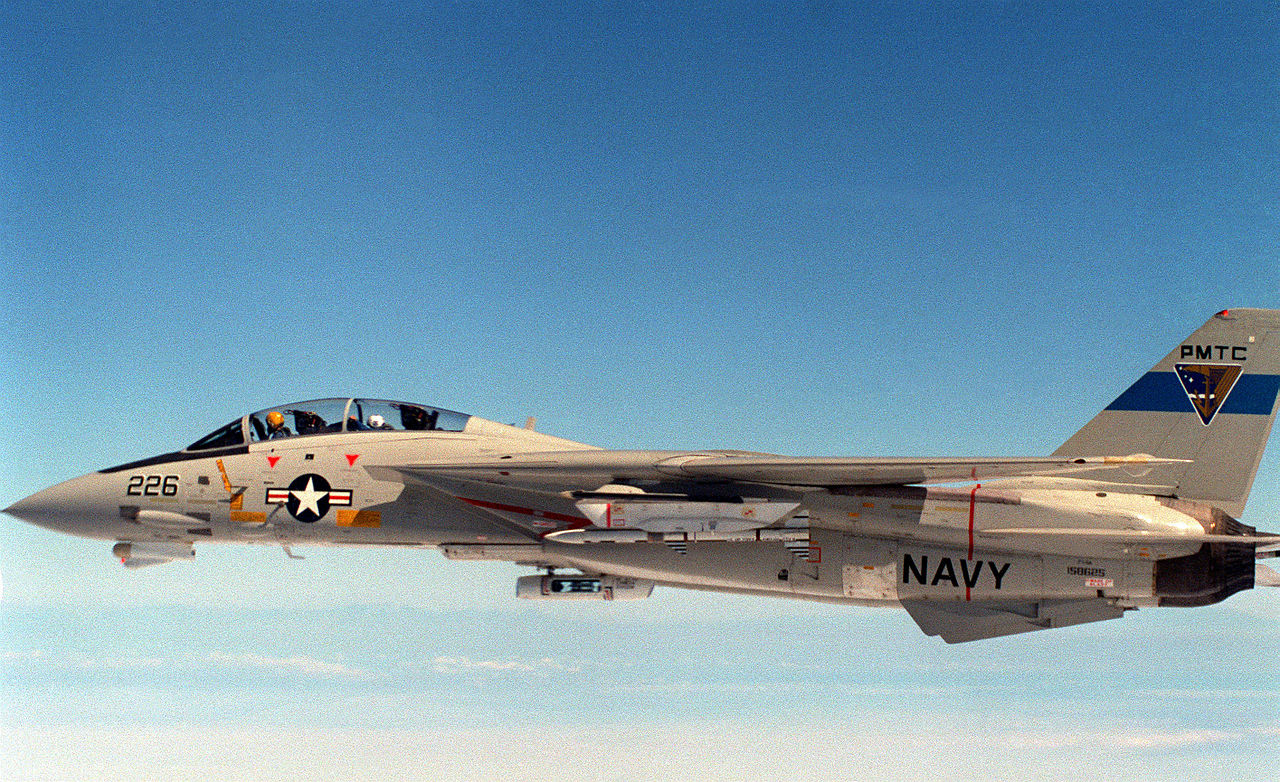
Noteworthy, as explained by the website Home of M.A.T.S., the F-14A/B/D could not carry and fire the AIM-120 because, even though missile tests were conducted, the integration of the AMRAAM into fleet Tomcats was rated as too costly.
‘I want to know which jet is your favorite AIM-120 (AMRAAM) platform,’ “Virus,” the callsign of a former F-14 RIO with VF-211 Checkmates in the late 90s/early 2000s, says on his Instagram profile, Tomcat_cockpit_pov.

‘I’ll go first: the Tomcat. Yeah, you heard me, and yes, I want to fight about it. The Navy actually tested the AIM-120 on the F-14…successfully! Indeed, in a 1994 Congressional report, the Director of National Security stated, “The Navy does plan to add the capability to launch the [AMRAAM] to F-14Ds when their computer software is updated.” That same report concluded, however, that the projected costs of many other planned upgrades to the Tomcat were not justified in light of the Hornet’s and upcoming Super Hornet’s capabilities. Eventually, plans to arm Tomcats with AMRAAM were scrapped.’
Virus concludes;
‘I refuse to cry (in public) about this, though, because the Tomcat had the Phoenix. Why would we want a Diet Phoenix, too?’

The AMRAAM program completed its conceptual phase in February 1979, when the US Air Force (USAF) selected two out of five competing contractors, Hughes Aircraft Company and Raytheon Company, to proceed into the validation phase.
Throughout the 33-month validation period, the contractors progressed with missile development by creating actual hardware to showcase their technological concepts. This phase of the program ended in December 1981, after both contractors proved that their flight-test missiles could fulfill the Air Force and Navy’s requirements. Hughes Aircraft Co.’s Missile System Group in Canoga Park, California, was chosen by the Air Force as the full-scale developer through a competitive selection process.
During the full-scale development stage, Hughes Aircraft Co. completed missile development, and Raytheon was chosen as a subsequent manufacturer. In 1987, a production contract was granted to both companies. Over 200 test missiles were fired during flight testing at Eglin AFB, Florida; White Sands Missile Range, New Mexico; and Point Mugu, California.
Photo by US Navy


