

Royce Williams and his epic, 15-minute dogfight
On November 18, 1952, a dramatic 15-minute aerial battle occurred southeast of Chongjin, North Korea, as three F9F-5 jets engaged in a fierce dogfight with seven MiG-15s.
According to Warren Thompson in his book F9F Panther Units of the Korean War, the cloud cover that day was just 500 feet above the icy Sea of Japan. Visibility was limited to about two miles due to blowing snow, while a fierce Siberian blizzard howled over the pitching, rolling shapes of the ships forming TF 77.
Aboard the USS Oriskany (CV/CVA-34), the flight deck crew positioned two F9F-5 Panthers from VF-781 onto the catapults. Lt. Claire Elwood, leading the division, and his wingman, Lt. (jg) John Middleton, advanced their throttles and held the jets steady with the brakes. They were launched off the bow one after the other, dipping close to the gray sea as they brought in their landing gear. Section leader Lt. Royce Williams and his wingman, Lt. (jg) David Rowlands, lined up behind Elwood and Middleton. Buffeted by the Siberian blizzard and blowing snow, all four dark blue jets quickly vanished into the swirling flurries and clouds, climbing with their noses up at a powerful 5,000 feet per minute.
Bogies had been detected
While each pilot struggled to keep the others in sight, a sudden burst of radio chatter announced that unidentified aircraft had been spotted 83 miles to the north, heading straight toward the task force. The command was clear—intercept. After climbing through the clouds for two minutes, the surroundings brightened, and all four pilots suddenly emerged into clear skies at 12,000 feet. ‘None of us had ever flown together before’, Royce Williams explained to historian Thomas McKelvey Cleaver in 2012. `When the carrier decided to launch an extra CAP, the squadron gave it to the four of us because, for various reasons, we hadn’t been able to fly a lot recently. My first mission in ten days after catching a cold had been the strikes against Hoeryong that morning’.

From four against seven to two against seven
The four Panthers kept pushing higher. When they reached 16,000 feet, Section Leader Williams noticed seven contrails far above them, likely at 40,000 feet or more. Moments later, he caught sight of sunlight glinting off the swept wings of seven MiG-15 jets, flying side by side with the Soviet red star emblazoned on their sides. ‘I flipped my gunsight and fired a burst to test my guns. At that moment, Lt. Elwood, the Flight Leader, reported his fuel pump warning light had come on. The CIC [Combat Information Center] directed him to report overhead the Oriskany. He passed the lead to me and turned back in the direction of the task force, with his wingman flying as his safety escort’. The situation shifted from four against seven to just two against seven as the MiGs kept coming. Williams continued his climb.
Royce Williams alone against six MiGs
`We were just going through 26,000 ft when the Russians split up and dove out of the contrail layer—the first ones came at us from the side in a four-aeroplane formation, shooting. I pulled into a hard, climbing left turn and came around on the Number Four MiG. I fired a burst, and he went down smoking. My wingman then followed him down, leaving me alone.’ The odds were now one against six. The three remaining MiGs of the first group climbed to position themselves for another firing run. They reversed course, and Williams turned into them again and again, firing as they flashed by at a very high closure rate. ‘They had me cold on manoeuvrability and acceleration—the MiG was vastly superior on those counts to the F9F.’
The remaining three MiGs soon joined in, leaving Williams in the midst of a dogfight against six enemy fighters—an overwhelming matchup for an aircraft not designed for such odds. Dodging and maneuvering rapidly, he noticed a MiG getting onto his tail, prompting him to make a sharp evasive turn. More than once, he managed to track individual MiGs and fire shots that appeared to hit his target, but he could not follow these bursts up, instead trying to keep his ‘six o’clock’ clear. ‘I was firing at every MiG that passed within gun range as they came by’, he recalled. Williams kept the Panther at full throttle, each time turning into the enemy fighters as they commenced a firing pass.
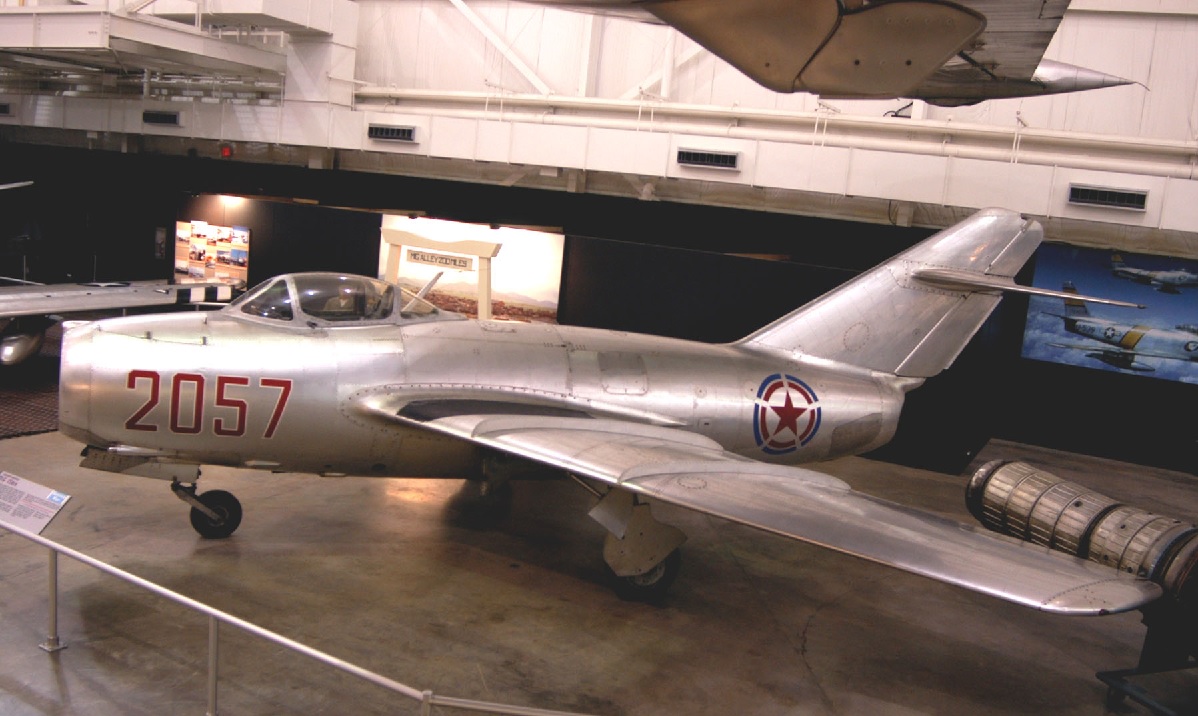
Royce Williams shoots down four MiG-15s in one dogfight
‘Finally, the leader and wingman went off to the right while I went after the section leader of the aeroplane I’d shot down. He went into the sun, and I lost him. Then I saw the leader and wingman come around for a diving attack on me. I turned into them and fired at the leader. He turned away, and the wingman rolled down on me, and we went past belly-to-belly as I raked him with a long burst. He went down on fire’.
Williams duly pulled up and away from the burning enemy fighter. ‘The section leader then came around, and I turned into him and opened fire. He too went down. The leader then came around again, and I fired, and parts came off him as he dove away’. In the light of his life, Royce Williams had done what no other American pilot had accomplished in the Korean War—the shooting down of four MiG-15s in one mission. But the light was not over.
‘As I maneuvered to avoid the wreckage, I was porpoising to try and clear my tail. I was tracking another wounded MiG when I suddenly spotted one of the others as he slid in on my six. He fired a burst with his 37 mm cannon and hit me in the wing. The shell went into the engine and messed up the hydraulic unit in the accessory section, and I suddenly lost rudder and flaps, and only had partial aileron control. The only things that really worked were the elevators. I dove toward the cloud deck below at 13,000 ft, and he was 500 ft behind me and still shooting. My wingman finally got back in the fight and came in on him, and he pulled away as I went into the clouds’.
Fighting for control of the Panther
Williams was in serious trouble, fighting for control of the Panther as it dived towards the sea. ‘I came out of the clouds at around 400 ft, and I was too low to eject—you had to be above 1200 ft and climbing to successfully eject from a Panther, so I was stuck with staying in the aeroplane, like it or not. I soon discovered it was uncontrollable below 170 knots, so I had to maintain high speed regardless’. It also did not help that several of the destroyers escorting the task force opened fire on Williams as he passed a few hundred feet overhead. ‘Fortunately, I was low enough that they didn’t have a chance to really aim, so nobody hit me’.
Aboard Oriskany, the flightdeck was cleared for what was obviously going to be a crash landing. ‘I didn’t want to ditch, because I wasn’t sure I could do it successfully in my damaged aeroplane. I also knew that the water was so cold I wouldn’t last ten minutes even in my poopy suit’. The Panther’s normal landing speed was 105 knots. Williams kept the bucking jet under control as he made a straight-in approach, maintaining 170 knots. ‘The captain of Oriskany headed the ship just away from the wind, which gave me the opportunity to come aboard, and I caught the three wires and shut her down’.
263 holes in the aeroplane
Williams climbed out of the riddled jet and stared at the damage, surprised he had made it back. ‘They counted 263 holes in the aeroplane, mostly from 23 mm hits—there were some 37 mm hits too, including the one in the wing that went into the engine. I had fired off all 760 rounds of 20 mm I had aboard. I wouldn’t have had a chance if I hadn’t been armed with those 20 mm cannon’. After removing everything of value from BuNo 125459, the deck crew heaved the broken carcass overboard, and it disappeared into the dark sea.
Credited with just one kill
Despite his extraordinary actions, Royce Williams was officially recognized for only one kill and one probable aircraft damaged during this mission.
The explanation was straightforward. At the time of the incident, Task Force 77 was operating only 90 miles from Vladivostok. With radar tracking the communist planes as they approached from that direction, it was clear these were Soviet MiGs. Leaders in the US and UN were deeply concerned that a clash between American and Soviet forces, like this one, could escalate the Korean conflict into a global war. Vice Adm. Robert P. Briscoe, Commander of Naval Forces Far East, warned Williams to tell no one about the fight. He also revealed that an NSA team on the cruiser USS Helena (CL-50) had intercepted all Soviet radio transmissions before and during the dogfight, providing evidence that Williams had actually shot down at least three MiGs and that a fourth had crash-landed.
The Russians reveal that Williams had indeed downed four MiG-15s
After the Cold War ended, Russia confirmed in 1992 that Williams had actually shot down four MiG-15s. These jets were piloted by Captains Belyakov and Vandalov, and Lieutenants Pakhomkin and Tarshinov of the VVS-PVO—the Soviet Air Defence Forces. Vandalov, Pakhomkin, and Tarshinov were directly downed in the battle, while Belyakov, the leader, was severely damaged by Williams and crash-landed fatally after crossing back into Soviet territory. This extraordinary achievement made Royce Williams the leading Naval Aviator of the ‘forgotten war’—a record that remains unmatched.
F9F Panther Units of the Korean War is published by Osprey Publishing and is available to order here.

Photo by U.S. Navy and U.S. Air Force

